Mutual Action Plans That Actually Get Executed
Why most MAPs become decoration — and the three changes that turn them into deal-moving artifacts.
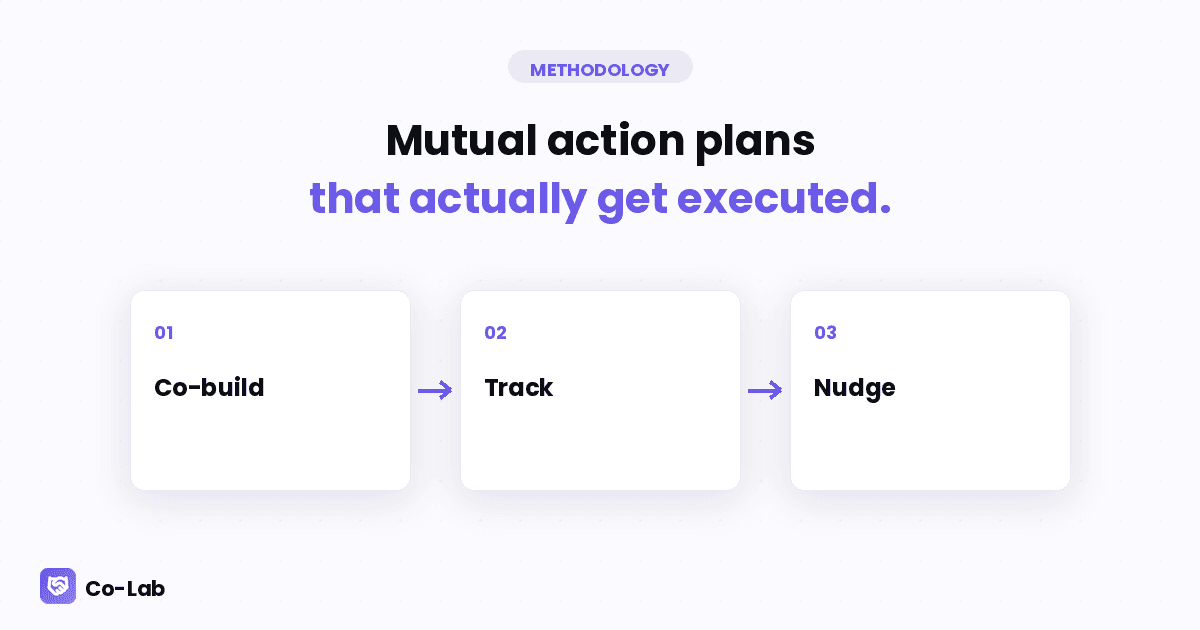
Every sales methodology insists on the mutual action plan (MAP). Force, MEDDIC, Sandler — they all have a version. The MAP is supposed to be the artifact that aligns buyer and seller on what happens next.
In practice, most MAPs become decoration. They get written once, never updated, and quietly ignored. The deal closes (or doesn't) for reasons unrelated to the document.
Three changes turn that around.
Change #1: Co-build it, don't deliver it
The standard motion: AE writes the MAP after the discovery call, sends it to the buyer, asks them to "review and adjust."
The buyer never adjusts it. They received it, they don't know if they're allowed to push back, they don't see themselves in it. They file it.
The fix: co-build the MAP live during a 20-minute working session with the champion. Open a shared document. Type as they talk. Ask "when do you think the security review can realistically happen?" and let them tell you. Type their answer.
This sounds like extra friction. It's not. The 20-minute session replaces 4 weeks of MAP-drift later because the buyer now feels accountable to the dates. They wrote them.
Change #2: Make it visible in their daily workflow
A MAP buried in a PDF attachment is dead. A MAP that lives at the top of a deal room they revisit weekly is alive.
Mechanism: put the MAP block as the second or third thing in your deal room (after the hero and recap). Every time the buyer opens the room — to grab pricing, to share with a colleague, to reference the integration spec — they see the MAP. They see what's overdue.
Bonus: when other stakeholders open the deal room, they also see the MAP. The MAP becomes the artifact the CFO uses to ask the champion "what's the status on the security review?" Internal accountability gets surfaced without the AE having to create it.
Change #3: Auto-generate it from the call
The biggest reason MAPs don't exist: nobody has time to write them. The AE just had a 60-min call, has 3 more calls today, and the MAP is the artifact that gets pushed to "later."
Modern AI tooling generates the first draft of the MAP from the call transcript. Every "we'd want to start by Q2" or "we'd need to loop in legal" is captured. The AE doesn't write a MAP from scratch. They review and edit one.
Generation time: 30 seconds. Editing time: 5 minutes. Total: 5.5 minutes from "had the call" to "MAP shipped to the buyer."
That's the threshold below which AEs actually do it. Above it, they don't.
What a great MAP looks like
Five-column structure:
| Step | Owner | Due | Status | Notes |
|---|---|---|---|---|
| Technical eval kickoff | Maya (their tech lead) | Mar 14 | Open | Sandbox env provisioned |
| Pricing approval | Tom (their CFO) | Mar 21 | Open | ROI doc shared |
| Security review | Citadel (us) | Mar 18 | In progress | SOC 2 sent |
| Legal redline | Sarah (their legal) | Apr 1 | Not started | |
| Contract signature | Champion | Apr 8 | Not started |
Note what's there:
- Specific names, not titles
- Real dates, not "Q2"
- Status that updates, not just "open"
- Notes column for context that would otherwise live in email
Note what's not there:
- "Demo" (already happened)
- "Discovery call" (already happened)
- Generic milestones with no owner
A great MAP only includes things that haven't happened yet. Everything else is context, not action.
The biggest mistake: too many steps
A 14-step MAP is theater. Nobody executes 14 steps. The buyer reads it, decides it's overwhelming, files it, never opens it again.
The discipline: 5-7 steps maximum. If your sales process has 14 actions before close, group them. "Technical evaluation" is one step that contains four sub-actions. Surface only the sub-actions if they get blocked.
Five steps is the upper limit of what a busy buyer will mentally track. Beyond that, the MAP becomes an obstacle instead of a tool.
Tracking execution
The MAP is only as good as your discipline of updating it. Two practical patterns:
Weekly nudge. Every Monday, send your champion a one-line message: "MAP check — anything we should adjust?" If they say "no, looks good," update the dates if needed. If they say "actually, the security review slipped to next week," that's signal — the deal is moving sideways.
Auto-flag overdue items. If your tool supports it, set up alerts for steps that are past due. The alert goes to both you and the champion. The mutual visibility is the accountability.
Most MAPs that get executed have one of these two patterns. Most MAPs that drift have neither.
When the MAP fails to move
Sometimes the MAP just stops. A step that was due last week is still showing "in progress" three weeks later. Nothing is moving.
This is the highest-signal moment in the deal. The MAP failure is the deal failing in slow motion.
The right move: stop trying to update the MAP. Get on a call with the champion and have the honest conversation. "We had this targeted to close by [date]. We're 3 weeks past where we expected to be. What's actually happening on your side?"
The answer is usually one of: budget got pulled, internal priority shifted, executive sponsorship eroded, competitor came in. Whatever it is, it's better to know now than to keep emailing about MAP steps that aren't going to move.
What this means for your team
A MAP isn't a methodology requirement. It's a forcing function for honest deal-state awareness — for both you and the buyer.
The teams that get value from MAPs treat them as living artifacts in the deal room. The teams that don't treat them as a checkbox on the methodology audit.
Pick three active deals this week. Co-build the MAP with each champion in a 20-minute session. Watch what happens to those deals over the next 30 days vs. your control deals where the MAP exists as a dead PDF.
The MAP that lives moves the deal. The MAP that doesn't is paperwork.
Want MAPs auto-drafted from your call transcripts? Co-Lab generates them. Free at colabapp.ai, code SALES for 3 months.
More from the blog
Keep reading.
The Hidden Cost of the "Quick Sync" Call
Why every "let's set up a quick call" is a 3-day deal delay — and what to do instead.
Multi-Threaded Selling Without Burning Your Champion
How to bring more contacts into a deal without making your champion feel circumvented.
Closing Velocity: Why the Best AEs Send Less Email
The counter-intuitive pattern in our top-quartile performer data.