Champion Vetting: How to Tell If Your Internal Advocate Is Real
Four signals that distinguish a real champion from a friendly contact who's about to ghost you.
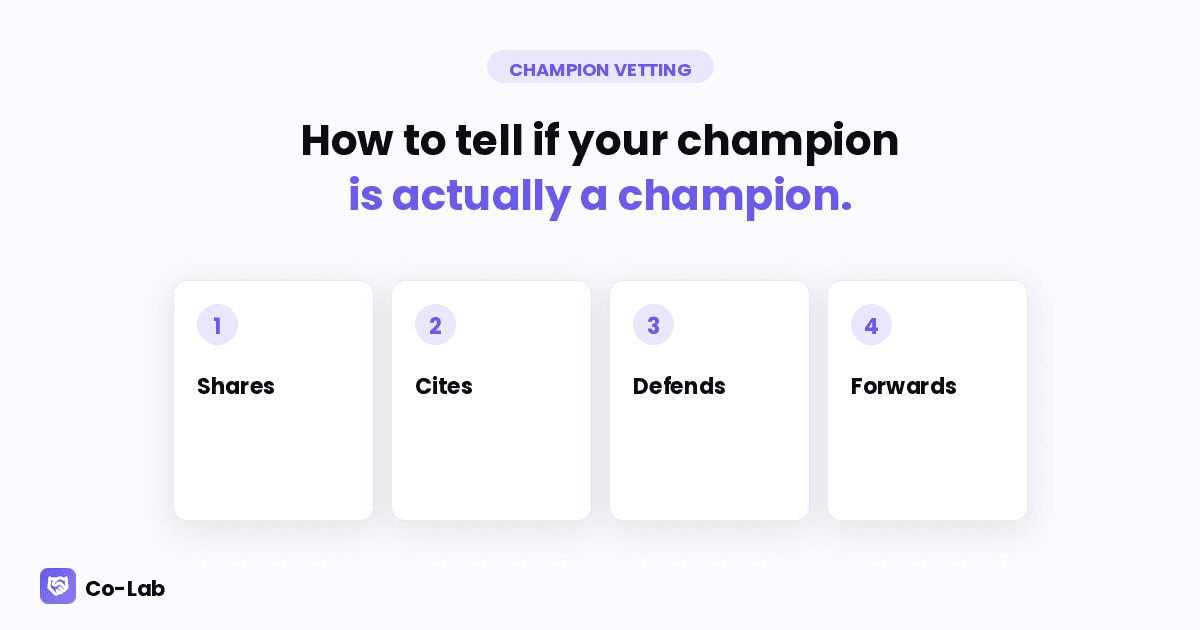
Every B2B AE has lost a deal to a "great champion" who turned out to be a dead end. They were enthusiastic on the call. They asked smart questions. They said "we're definitely moving forward" — and then disappeared.
The post-mortem is always the same: the contact wasn't a champion. They were a friendly tourist. There's a difference.
Here are the four signals that distinguish them.
1. They share your content without prompting
A real champion forwards your deal room to their boss without you asking.
A friendly tourist doesn't. They open it. They like it. They don't share it.
Why this matters: sharing internal artifacts requires political capital. Every time someone forwards your stuff to their boss, they're putting their reputation behind it. People don't spend that capital on tools they're "kind of interested in." They spend it on tools they want to win for.
How to detect: if your deal room shows opens from a second email domain (their company's CFO, procurement, etc.) without you having sent it directly, your champion forwarded it. That's the highest-trust signal in B2B sales.
Counter-test: if a week passes after a great call and only your champion has touched the deal room, they haven't shared it. Ask directly: "Have you been able to loop in [name]?" The answer reveals everything.
2. They quote you in the next conversation
A real champion uses your specific framing when they describe your product to their team.
A friendly tourist describes your product in their own terms — usually less accurate, less compelling.
Why this matters: champions internalize the pitch. They make it theirs. When they talk about your product internally, they sound like you. That's how the pitch survives the room you're not in.
How to detect: on a follow-up call, listen for how the champion describes the product to a new stakeholder you've added. If they say "this lets us do X" using your exact framing, you have a champion. If they say "they have some kind of tool that..." you have a friendly tourist.
3. They push back
A real champion challenges you. They ask hard questions. They tell you what won't work in their environment.
A friendly tourist agrees with everything. They nod. They say "great." They don't push back.
Why this matters: champions are invested. They want this to work. They surface the friction because they need to solve it. Friendly tourists don't push back because they don't actually care if it works — they're just being polite.
Counter-intuitive corollary: the more your champion criticizes your product on a call, the higher the close probability. The buyer who lists 5 things they're worried about is the buyer who's mentally already committed to making it work.
The buyer who says "everything looks great, we'll be in touch" is the buyer you're about to lose.
4. They make small commitments early
A real champion does small things you ask. Schedules an internal stakeholder call. Sends you the org chart. Books time with their CFO.
A friendly tourist agrees to do these things and then doesn't.
Why this matters: small commitments compound. A champion who's done three small things for you in the first two weeks has built momentum. A champion who's done zero is signaling they don't have the political capital — or the interest — to do the bigger things later.
How to operationalize: structure every call to end with a small ask. "Could you send me [X] this week?" or "Could you set up 15 min with [Y]?" The execution rate on these asks is your champion vetting score.
A 100% execution rate over 2-3 small asks = real champion. A 50% execution rate = at-risk; need to confirm. A 0% execution rate = friendly tourist; the deal is dead and you don't know it yet.
What to do when you've vetted and they're not a champion
The friendly tourist isn't useless. They're just not your path to close.
Two moves:
1. Ask for the actual champion. "I appreciate you helping me understand the landscape — who else on your team would be the most invested in actually rolling this out?" The friendly tourist will name the real champion. Make that introduction the next step.
2. Don't burn the friendly tourist. They're a low-cost ongoing relationship. They might become a champion at a different company in 18 months. Stay warm.
What you don't do: keep treating them as your primary path. Every additional call you spend with a friendly tourist is a call you're not spending finding the real champion.
The vetting timeline
You can vet a champion within 2-3 interactions. Don't wait 6 weeks to figure out you've been talking to a tourist.
After the discovery call: signal #4 (small commitment). Did they do the thing they said they'd do?
After the second call: signal #1 (sharing). Has anyone else opened the artifact?
After the third interaction: signal #2 + #3 (quoting and pushback). Are they talking like you talk? Are they raising friction?
If three of the four signals are missing by the third interaction, the deal isn't going to close. Re-strategize before you waste another month.
What this means for your team
Champion vetting is the highest-leverage skill in B2B sales because everything downstream depends on it. The proposal, the pricing negotiation, the executive sponsor relationship, the renewal — all of it routes through the champion.
Get this right and the rest gets easier. Get this wrong and you're working on deals that were never going to close.
Build the four signals into your team's pipeline review. Mark every "champion" as Real, At-Risk, or Tourist. Watch how quickly your team's pipeline accuracy improves.
Want to detect champion sharing automatically? Co-Lab tracks which deal-room views came from forwarded links. Free at colabapp.ai, code SALES for 3 months.
More from the blog
Keep reading.
Stalled Deals: 6 Engagement Signals You Missed Before It Went Cold
The signals that show up 7-14 days before a deal officially stalls — and what to do when you see them.
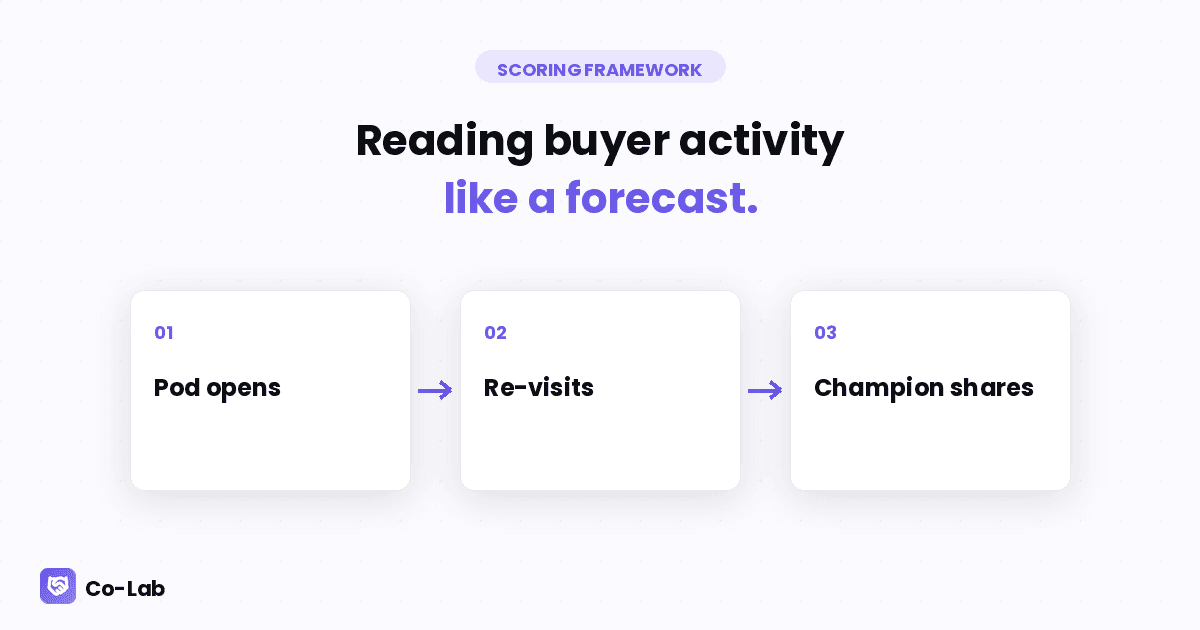
Reading Buyer Activity Like a Forecast
A practical scoring framework for turning engagement data into deal-state insight.
Why Your CRM Misses 80% of the Buyer Journey
The signals living outside Salesforce that predict deals better than anything in it.