The AI Sales Stack in 2026: What Actually Works
Cutting through the 200+ "AI sales tools" pitches landing in your inbox to the four categories that move pipeline.
If you've been on a sales tech buying committee in the last 18 months, you've seen the inbox flood: every CRM add-on, every enrichment vendor, every meeting tool now ships with "AI" in the name. Most of it is theater.
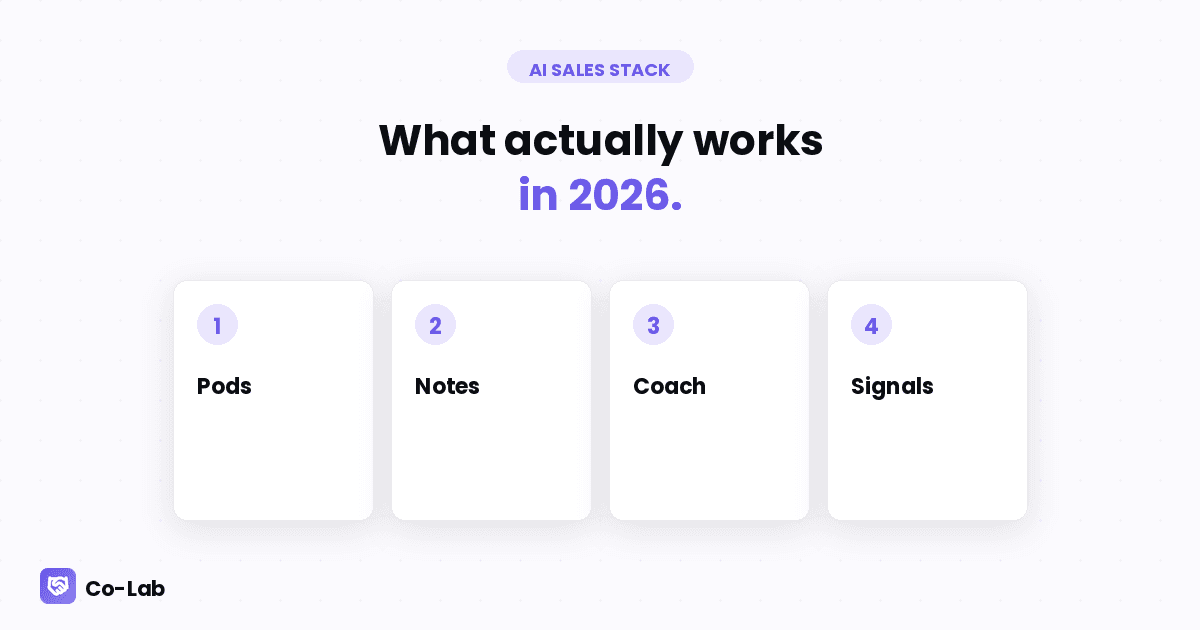
Underneath the marketing, four categories of AI tooling are actually moving sales numbers. Everything else is feature noise.
1. AI that builds artifacts (not just notes)
The first wave of AI sales tooling was note-taking. Gong, Fathom, Otter. Useful, but the artifact stops at the transcript — and a transcript is not a deal-mover.
The 2026 wave generates artifacts buyers actually receive: deal rooms, follow-up emails, custom proposals, mutual action plans. The transcript is the input. The buyer-facing artifact is the output.
If your AI tool ends at "we summarized your call," it's a 2024 product. If it ships a buyer-facing thing your customer can open, that's the new bar.
2. AI that reads buyer activity (not just your activity)
Your CRM tracks what you did — emails sent, calls logged, stages advanced. None of that predicts whether the deal closes.
What predicts closing is what the buyer did. Did they open the deal room? Did they re-visit the pricing section? Did they share the link with a procurement contact? Did the technical contact spend 8 minutes on the integration page?
A small but growing category of tools is finally surfacing this signal. The good ones don't drown you in dashboards — they tell you the one move that matters this week per deal.
3. AI that coaches reps in real time (not in the QBR)
The old model: record calls, review them weekly, give feedback in the 1-on-1. The lag between the rep saying the wrong thing and getting feedback is 5-10 days. By then they've said it 30 more times.
The new model: AI surfaces the issue inside the deal, in real time. "Your champion went silent — here's the email to send." "The technical eval is stalled — here's the asset to share." Coaching becomes a deal-level nudge instead of a quarterly retro.
This category is still early. Most "AI coaching" tools just summarize the call. The ones that prescribe specific actions inside the active deal are rare and underpriced.
4. AI that personalizes at scale (not the same email blast)
Sequence tools have had "personalization tokens" for a decade ({{first_name}}, {{company}}). That's not personalization, that's mail-merge.
Real AI personalization reads the buyer's actual context — their company news, their recent LinkedIn activity, the specific pain they mentioned on the discovery call — and generates a unique outbound for each prospect. Not at sequence-blast volume. At a few-deals-a-day cadence where the rep can actually review and ship.
This is the category most likely to over-promise and under-deliver. The good ones are obvious; the bad ones flood your sequences with content that sounds like a chatbot.
What's noise (and you can skip)
- "AI" CRM features that are just better search
- Generic enablement chatbots that answer questions reps could find in Notion
- Auto-dialers with sentiment analysis (this never moved the needle)
- AI-written cold emails that all sound identical to every other AI-written cold email
- Predictive lead scoring when you don't have enough data to predict anything
If a tool's pitch starts with "AI-powered" and doesn't end with "ships an artifact your buyer sees" or "tells you the next move on a specific deal," it's not the move.
How to evaluate one without getting fooled
A useful filter: ask the vendor to show you what changed in their pilot customers' deals, not their pilot customers' workflows.
Workflow demos are easy. "Watch how fast we generate a summary." Cool. Did the summary get more deals to close?
If they can't tell you, they're selling shelfware. The good vendors will quote you a metric that survives a forecast meeting — close rate, time-in-stage, win rate against a specific competitor.
What this means for your team
The 2026 AI sales stack is small. Maybe 3-5 tools across the four categories above. If your stack has 12 AI vendors in it, you're spending money on overlapping capabilities and your reps are paying the cognitive tax of switching between them.
Audit by category, not by feature list. Pick one tool per category. Cut the rest. The teams winning right now don't have more tools — they have fewer, better ones, deployed deeply.
Want to see what the deal-room category looks like in practice? Try Co-Lab free at colabapp.ai. Use code SALES at signup for 3 months on us.
More from the blog
Keep reading.
The Limits of AI in B2B Sales (And Where Humans Still Win)
An honest list of jobs not worth automating yet — from someone who builds AI sales tools.
Why AI "Wrappers" Are Beating Custom-Built Sales Tools
The contrarian case for buying the boring product on top of GPT-4 over building your own.
5 Things You Can Do With a Sales Call Transcript Beyond Note-Taking
The transcript is the most underused asset in your sales workflow. Here's how to extract real leverage from it.