Deal Rooms vs Sales Decks: When to Use Which
A practical decision guide for sales leaders who've been told "decks are dead" but still need them sometimes.
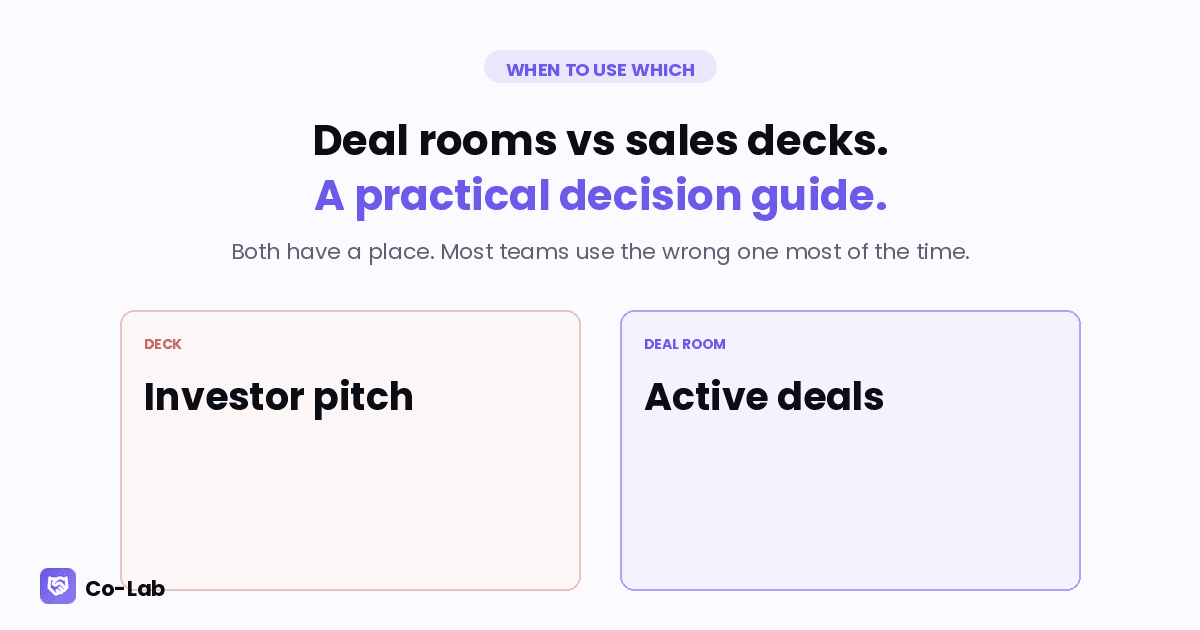
The "decks are dead" take is half-right. Sales decks aren't dead — they're being misused for jobs they were never built to do.
Here's when to use which, and the specific situations where each one wins.
What sales decks are actually good for
A deck is a linear, timed, one-shot artifact. It works when:
You're presenting in person or on a screen-share. Slides are a teleprompter for a human. They're useless without that human.
You need a fixed narrative arc. A pitch deck for an investor. A QBR slide deck. A board presentation. The story is the same every time and the presenter walks the audience through it.
The audience is captive. They're sitting in a conference room or on a Zoom call. They're not going to navigate. They want to be led.
You want to enforce sequence. Some content only makes sense after other content. Decks are good at "first you see X, then Y, then Z."
For these jobs, decks are still the right tool. Don't let the deal-room hype convince you otherwise.
What deal rooms are actually good for
A deal room is a non-linear, persistent, multi-touch artifact. It works when:
The buyer will revisit the content over days or weeks. Not a one-shot read. A reference they keep coming back to.
Multiple people on the buyer side will see it. Champion, manager, CFO, technical eval, procurement. Each one needs different content.
The content needs to update over time. Pricing changes. New case study lands. Mutual action plan progresses.
You need engagement signal. Who opened what, when, for how long.
These are the jobs decks were never designed to do. Trying to do them with a deck means sending 5 different versions to 5 different stakeholders and losing track of which version each person has.
The decision matrix
| Job | Use a deck | Use a deal room |
|---|---|---|
| Investor pitch | ✓ | |
| Board presentation | ✓ | |
| Cold inbound demo | ✓ | |
| Discovery call follow-up | ✓ | |
| Mutual action plan | ✓ | |
| Pricing + proposal | ✓ | |
| Technical evaluation | ✓ | |
| Multi-stakeholder review | ✓ | |
| QBR (existing customer) | ✓ | |
| Champion enablement | ✓ | |
| One-time sales pitch | ✓ | |
| Late-stage close | ✓ | |
| Renewal conversation | ✓ |
The pattern: decks for one-shot presentations, deal rooms for ongoing deal motion.
The mistake most teams make
The mistake isn't "we use decks too much." It's "we use decks for the deal-room job."
Specifically: sending a deck as a follow-up to a discovery call. The deck assumed a presenter, doesn't update, doesn't track, can't be navigated. The buyer opens it once on their phone in the parking lot, scrolls 3 slides, closes it, never opens it again.
That deck is doing the deal-room job badly. Replace it with an actual deal room and the conversion math improves measurably.
The other mistake
The reverse mistake also happens: trying to use a deal room as a deck. Walking a buyer through your pod live on a Zoom call, scrolling through every block, narrating every section.
That's a worse experience than a deck. Deal rooms are not designed for linear narration. They're designed for self-navigation.
If you find yourself screen-sharing a deal room and walking a buyer through it, you're using the wrong tool. Make a deck. Or just have the conversation without slides.
What about a hybrid?
A common pattern: present a deck on the first call, then send a deal room as the follow-up. This works.
The deck establishes the narrative. The deal room captures it for ongoing reference. Each is doing what it's good at.
What doesn't work: trying to put the entire deck into the deal room as a slide block. The buyer doesn't want to scroll through 25 slides on a webpage. The deck is a presenter aid; without the presenter, it's noise.
If you want to include the deck in the deal room, embed it as a downloadable PDF — there if the buyer wants to share it internally, not in their face on the page.
The leadership question
If you're a sales leader auditing your team's artifacts:
- Count how many decks your AEs send per deal. (Usually 2-4.)
- Count how many deal rooms they create per deal. (Usually 0.)
- Flip that ratio.
Most B2B SaaS sales motions need 1 deck (the pitch deck) and 1 deal room (per active opportunity). Not 4 decks and 0 deal rooms.
The teams that make the switch see compression in deal cycles within a quarter. The decks they kept are now better focused. The deal rooms they added do the work the decks were failing at.
What this means for your team
Don't kill your decks. Repurpose them.
The discovery deck becomes the deal-room hero. The proposal deck becomes the deal-room pricing block. The case study deck becomes the deal-room asset library. The mutual action plan slide becomes the actual mutual action plan.
The deck content was right. The container was wrong. Move it to the right container.
Want to see how a deck migrates into a deal room? Co-Lab does this automatically from your existing slide library. Free at colabapp.ai, code SALES for 3 months.
More from the blog
Keep reading.
The Death of the Email-Deck-Loom-Spreadsheet Cycle
Why the standard B2B sales follow-up is the worst buyer experience in software, and what's replacing it.
How to Close a Deal Without Another Sync Call
Three deal-room patterns that move late-stage deals while you sleep.
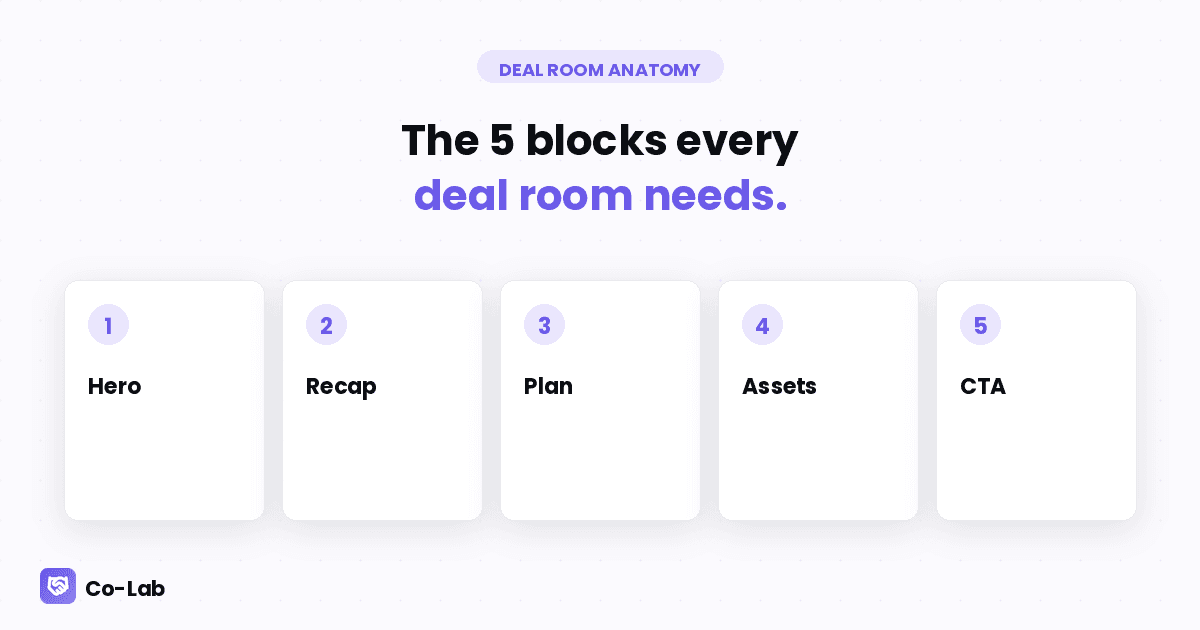
The 5 Blocks Every Deal Room Needs (And the 9 You Don't)
A minimum-viable structure for buyer-facing deal rooms — and the blocks teams add that don't move the needle.